

Effective Deployment of Teaching Assistants: EEF Recommendations in Practice
“Teaching assistants represent a significant proportion of the school workforce. They play a key role in helping pupils with SEN make progress and also contribute to many other areas of the school’s work.”
— Education Endowment Foundation (EEF), 2021
Teaching Assistants (TAs) are a vital part of the educational workforce.
When deployed effectively, they make a measurable difference to pupil outcomes — not only for those with Special Educational Needs and Disabilities (SEND), but across the classroom. However, research shows that the way TAs are used significantly affects their impact. In response, the EEF has published seven key recommendations to guide schools in maximising the value of their TAs.
1. Avoid Assigning TAs Exclusively to Lower-Attaining or SEND Pupils
Traditional deployment of TAs to support only lower-attaining pupils or those with SEND may inadvertently limit opportunities for independence and access to teacher-led instruction. Recent evidence indicates that this model is no longer the most effective.
2. Use TAs to Enhance, Not Replace, Teaching
TAs should supplement high-quality teacher instruction, not act as a substitute. Effective deployment involves positioning TAs to reinforce and deepen learning, not shoulder responsibility for instruction alone.
3. Promote Independent Learning and Self-Regulation
TAs should focus on developing pupils’ autonomy rather than task completion. Training should help TAs foster skills like self-management, problem-solving, and perseverance—particularly in pupils who may rely heavily on adult support.
“Enhancing the quality of TAs’ interactions with pupils can foster independent learning.”
— EEF, 2021
4. Ensure TAs Are Prepared for Their Role
TAs are most effective when they are well-informed and actively involved in planning. Schools should:
• Allocate time for teacher-TA collaboration outside class time.
• Consider creative scheduling (e.g., during assemblies, or incorporating TAs into PPA time).
• Share key lesson information, including concepts, skills, learning outcomes, and success criteria.
5. Deliver High-Quality 1:1 and Small Group Support
TAs can add up to three or four months of academic progress when delivering structured, well-designed interventions in one-to-one or small group settings. However, informal or unsupported delivery has been shown to hinder pupil progress.
6. Use Evidence-Based Interventions
Structured interventions—backed by research—are most effective when they:
• Are brief (20–50 minutes), regular (3–5 times weekly), and span 8–20 weeks.
• Include detailed TA training (5–30 hours).
• Are monitored for pupil progress and tightly aligned with class teaching.
7. Ensure Alignment Between Intervention and Classroom Learning
TAs and teachers must work closely to connect intervention work with everyday classroom teaching. This means:
• Coordinating planning and feedback.
• Ensuring consistency in learning goals.
• Helping pupils understand how both settings support their progress.
Collaboration is Key
Effective TA deployment depends on communication and collaboration. Pupils make the greatest strides when supported by both high-quality teaching and well-integrated TA support — not one in place of the other.
To make this work:
• Prioritise joint planning between teachers and TAs.
• Brief TAs daily with key objectives, success criteria, and pupil targets.
• Include TAs in progress reviews and planning meetings.
• Focus on developing pupils’ knowledge and skills—not just finishing tasks.
Ultimately, a shared understanding and a unified approach between teachers and TAs can significantly improve outcomes for all pupils — especially those who need additional support to thrive.
Yomna El-Guindy – SENCO at Old Ford Primary Academy
Weekly Writing Outcome #34
English
This week’s WWO comes from a Year 5 pupil from Murrayfield Primary Academy. The remit was to, as an independent piece of writing, detail Auggie’s journey through the story. This included thinking about his thoughts, feelings and actions, using evidence from the text to support, where possible.
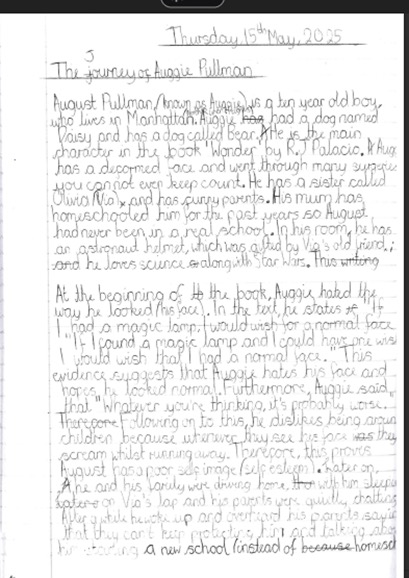
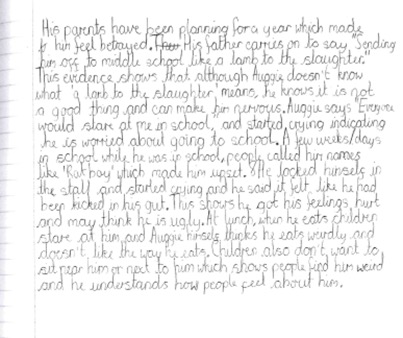
We have chosen this piece because it contains the following:
- the use of fronted adverbials;
- use of parentheses;
- conjunctions used to build cohesion;
- evidence and explanation.