Checking for understanding – Using what you want the pupils to Know, Do and Explain.

I want to focus on a powerful technique for checking pupil understanding and closing the gap between theory and practice in our lessons: the ‘Know, Do, Explain‘ framework.
The framework for an effective lesson includes the phases: Do Now, Teacher Input, Practice, Feedback, and Checkout. By aligning these phases with the learning objectives, you can create a clear pathway from acquiring knowledge to being able to explain it deeply.
Here is how each lesson phase contributes to this process:
1. Do Now
The ‘Do Now’ phase is designed to retrieve important knowledge, even if it’s not going to be used today, to activate and assess the foundational knowledge pupils may need for the lesson.
- How it works: This stage typically consists of three to five self-explanatory retrieval practice questions. Teachers can check for understanding by circulating purposefully around the classroom, using CFU, or having pupils respond on mini-whiteboards or with polls.
- Link to ‘Know, Do, explain’: This phase can link to the ‘Know’ component of the framework. It is used to review prior learning and may link to what pupils need to ‘know’ in the current lesson, ensuring they have the necessary building blocks before new content is introduced.
2. Teacher Input
This is the stage of direct instruction where the teacher introduces new concepts and skills.
- How it works: The teacher provides explanations and models the new material for the pupils.
- Link to ‘Know, Do, explain’: During Teacher Input, you are explicitly teaching the ‘Know’ (the facts, concepts, and information) and demonstrating the ‘Do’ (how to apply that knowledge). For example, you might explain that a two-digit number has tens and ones (Know) and then model how to build that number using dienes (Do). Teacher input needs to be chunked and practised.
3. Practice
The Practice phase allows students to apply what they have just learned.
- How it works: Pupils engage in tasks designed to use the new knowledge and skills.
- Link to ‘Know, Do, explain’: This phase is the pupils’ opportunity to ‘Do’. They actively work on tasks that require them to use what they ‘Know’. Examples from the sources include ordering and labelling the life-cycle of a frog or answering key questions about Florence Nightingale.
4. Feedback
Feedback is an interactive phase where learning is clarified, corrected, and reinforced.
- How it works: The teacher provides feedback on the pupils’ practice tasks, addressing misconceptions and reinforcing correct application.
- Link to ‘Know, Do, explain’: This phase bridges the ‘Do’ and ‘Explain’ stages. By giving feedback, you can assess the accuracy of the ‘Do’ task and begin to probe for deeper understanding, setting the stage for pupils to be able to ‘Explain’ their reasoning.
5. Checkout
The ‘Checkout’ is the final phase, designed to assess what students have learned by the end of the lesson.
- How it works: This could be an exit ticket, a final question, or a brief discussion.
- Link to ‘Know, Do, Explain’: This stage is a critical opportunity to check for the highest level of understanding: the ‘Explain’. At this point, you can determine if a pupil can articulate the ‘why’ or ‘how’ of their learning. For instance, can a pupil not only label a frog’s life cycle but also explain what happens at each stage using key vocabulary? Can they explain why Florence Nightingale was a significant historical figure, going beyond just stating facts?
By systematically mapping the ‘Know, Do, Explain’ objectives onto these distinct lesson phases, you ensure that each part of your lesson has a clear purpose in building and assessing student understanding at progressively deeper levels.
Shahidur Rashid
Weekly Writing Outcome
English
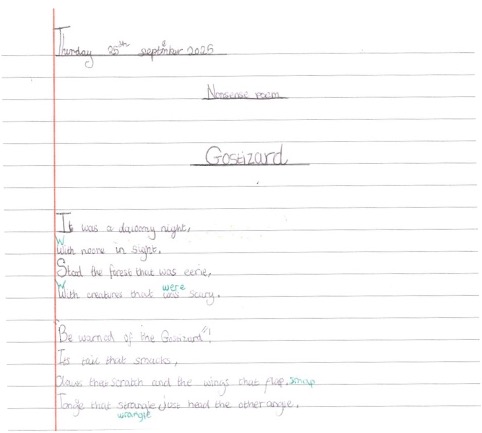
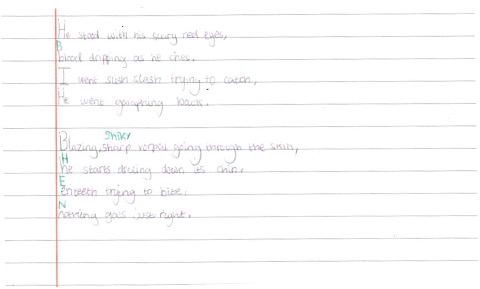
This week’s WWO comes from a year 4 pupil at Old Ford Primary Academy. The remit was to, as an independent piece of writing, write a poem based on our poetry unit.
We have chosen this piece because it contains the following:
1. Clear stanzas;
2. Mostly secure use of rhyming pattern AA,BB;
3. Vocabulary chosen for effect ‘blood dripping as he cries’.