The power of Gemini to support lesson adaptation
The challenge of meeting every pupil’s needs.
As our understanding of the needs of pupils has improved, planning to meet this challenge has become even more time consuming. Technology can support us.

The Pedagogy Network Group has produced a comprehensive guide for staff across Paradigm Trust, detailing how the AI tool Gemini can be used to adapt lessons and resources effectively. Far from being a replacement for the expertise of a teacher, Gemini is a powerful “thought partner” that helps create high-quality, inclusive materials in a fraction of the time.
Alignment with Rosenshine’s Principles of Instruction
The guide highlights how Gemini can be used to implement Barak Rosenshine’s Principles of Instruction, particularly through the automation of resource creation.
- Daily Review and Retrieval Practice: this principle emphasises the importance of daily review. Gemini can instantly generate “Do Now” quizzes, exit tickets, or five-word retrieval questions based on a previous lesson’s text, allowing for quick, low-stakes assessment of prior learning.
- Scaffolding for Difficult Tasks: For pupils who find a task challenging, Gemini can provide temporary supports or “scaffolds”. This includes generating word banks, sentence starters, or “knowledge organisers” that summarise main facts on a single page, helping to reduce the cognitive load on the learner.
- Presenting New Material in Small Steps: To avoid overwhelming pupils, teachers can ask Gemini to “chunk” complex tasks. For instance, a dense four-part essay task can be broken down into smaller, sequential steps of no more than ten words each, ensuring pupils can master one small step before moving to the next.
Integrating ‘Teach Like a Champion’ (TLaC) Strategies
Beyond cognitive science, the guide provides practical examples that align with Doug Lemov’s Teach Like a Champion techniques.
- “Right is Right” and Model Answers: To set a high bar for excellence, teachers can use Gemini to produce model answers – such as high-quality PEE (Point, Evidence, Explanation) paragraphs. This allows teachers to show pupils exactly what a “perfect” response looks like, driving up the standard of work.
- Check for Understanding: A core TLaC principle is checking for understanding frequently. Gemini can create multiple-choice questions (MCQs) with plausible distractors – incorrect answers that reflect common misconceptions. This helps teachers identify exactly where a pupil’s understanding is breaking down.
- Double Planning: Lemov advocates for Double Planning – planning what the teacher is doing and what the students are doing. Gemini supports this by generating tiered activities where the same objective is met through different levels of support, such as one version with prompts and another with an extension challenge.
Inclusion and SEN Adaptation
Perhaps the most significant impact of Gemini is its ability to support Special Educational Needs (SEN). The Pedagogy Network Group’s guide provides specific prompts to help students with diverse needs:
- Dyslexia and Literacy: Gemini can convert long lists of definitions into visual matching activities, reducing the reliance on dense text.
- Autism and Anxiety: For pupils who thrive on predictability, Gemini can design visual timetables or clear lesson structures for a 45 minute period, setting concrete expectations for the starter, main task, and plenary.
- ADHD: To support pupils who struggle with attention, the tool can adapt a standard worksheet into a walking debate, incorporating movement into the learning process.
A Note on Quality Assurance
While Gemini is a transformative tool, the Paradigm Trust guide is clear: it is not a replacement for the teacher. By combining the speed of AI with the pedagogical expertise of Paradigm’s educators, the Trust is ensuring that every lesson is precisely adapted to help every pupil succeed.
Chris Stewart, Pedagogy Network Coordinator and Pedagogy Lead at Ipswich Academy
Weekly Writing Outcome
PRE Writing
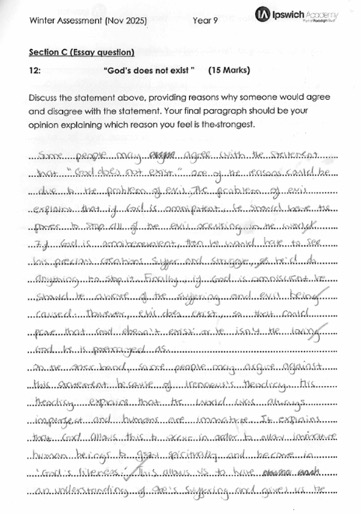
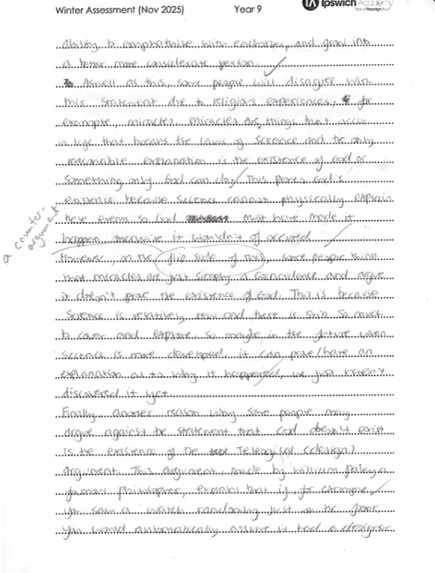
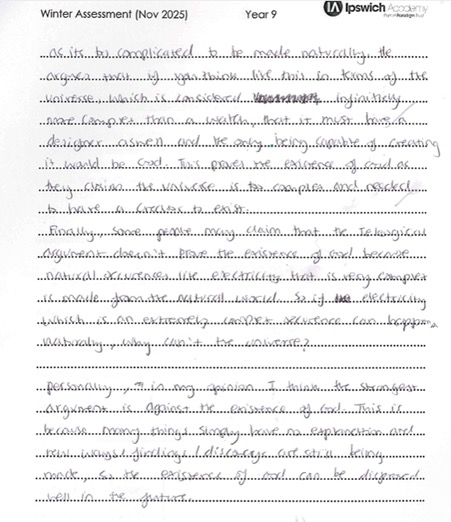
This week’s WWO comes from a year 9 pupil from Ipswich Academy. The remit was to, as an independent piece of writing, discuss the statement: God does not exist.
We have chosen this piece because it contains the following:
- It has a clear structure that provides a balanced response to the differing opinions about the statement;
- The language and terminology that is used is precise and accurate;
- Each of the points provided are clearly explained along with the possible counter arguments.